
When ¡HOLA! first talked with Carín León in June, his latest album MUDA was beginning to take shape as one of the most ambitious chapters of his career. Months later, the Hermosillo native has taken that transformation much further than anyone could have imagined.
Since our conversation, León has brought his genre-blending MUDA around the world, debuted in Japan, and made history in Las Vegas as the first Latin artist to headline Sphere. "This year, and all these years, have been full of a lot of very beautiful, very important moments. But June, with our trip to Japan and now with our residency at the Sphere, it's been a very mind-blowing year for us and a very important one," he told us during our catch-up session.
The milestones are impressive on their own, but together, they feel like a reflection of exactly what León told us MUDA was about—shedding an old version of yourself and refusing to stay inside the boundaries people expect you to.
 © Courtesy
“With all the happiness that we have and all the passion that we put into our work, it's just the result of a lot of work that we've been doing for a lot of years. And we're happy to live this, and we're happy to keep doing the most unexpected and incredible stuff in our music... More than anything, it doesn't feel like this is real. We always try to look for the incredible stuff, for the unbelievable stuff.”
In August, the global ambassador of Música Mexicana made his Japanese festival debut at Summer Sonic in Osaka, taking the stage at The Mountain, the festival's international stage, with the crowd, Japanese fans included, singing along.
The trip continued in Tokyo, where León made history as the first Mexican artist to headline a festival in the capital.
Then came Las Vegas
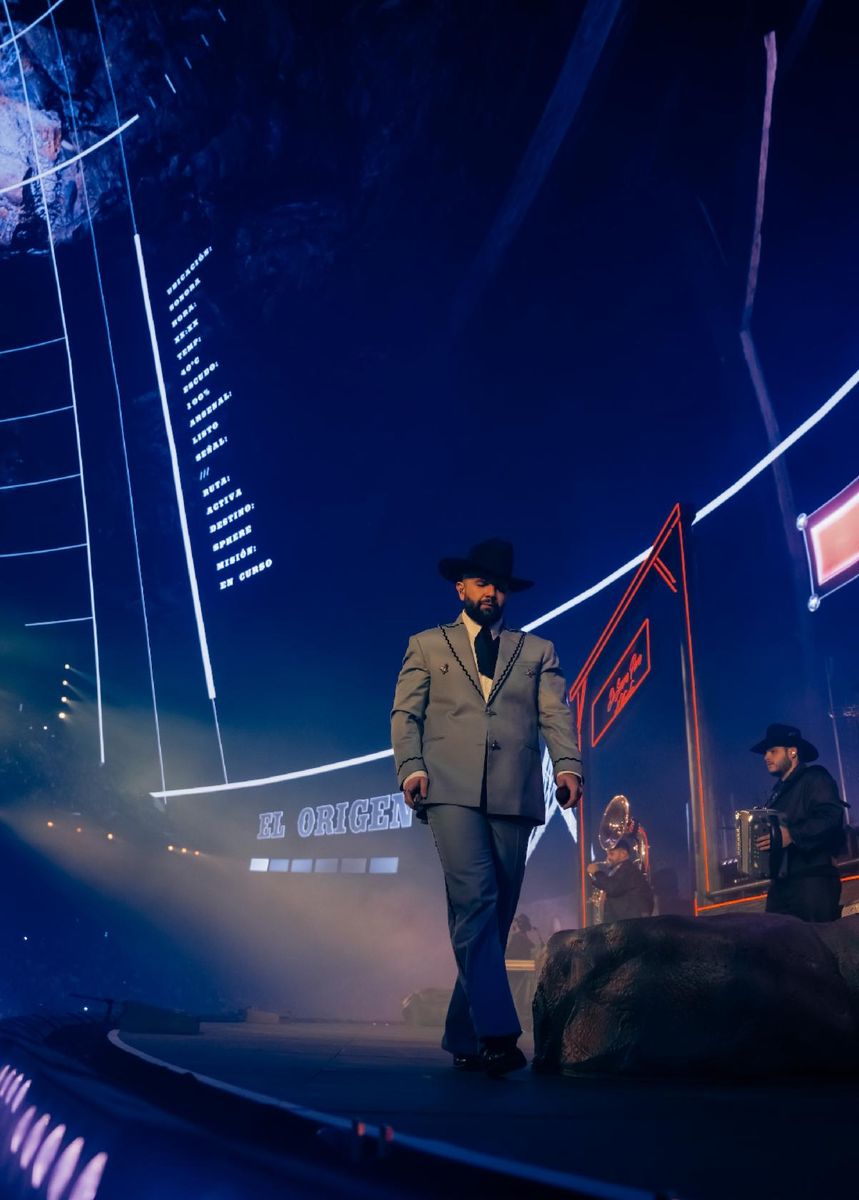
Just days later, León opened his seven-show residency at Sphere, and he is officially the first Latin artist to headline at the groundbreaking venue. His opening night sold out, with more than 17,000 fans filling the venue as he brought the Sonoran Desert to the Las Vegas Strip.
 © Victor Trani
For León, the milestone carried more than just career bragging rights. To him, it's "a lot of responsibility, a lot of honor, and a lot of joy to be representing Mexico in the most important venue in the world."
Even in Vegas, he keeps his roots on the stage. The residency leaned heavily into León's Sonoran roots, with denim, boots, oversized cowboy buckles, and the signature cowboy hat that has become part of his identity. The MUDA production was reimagined specifically for the immersive space, using Sphere's enormous LED screen and cutting-edge sound technology to create a visual experience unlike anything he had previously brought to a Spanish-language audience.
The goal goes beyond putting on a massive show. "We're so happy that the people feel proud about being Mexican and about being from this part of the world," he said. “You can see that people are having more than fun at a show. They feel like they are a part of something, and that's the goal of the show.”
But the bigger the stage gets, the higher the stakes become. Just days into his residency, León had to postpone his September 10 performance at the last minute after he was unable to get from Hermosillo to Las Vegas. The announcement came after fans had already arrived at the 20,000-capacity venue, prompting boos and frustration from the crowd and social media.
 © Courtesy
León later explained that the first plane he was scheduled to take developed brake problems around 3 p.m., while a second aircraft experienced steering issues around 5 p.m. He said authorities ultimately would not allow them to fly.
"Every milestone opens another door. Every new place we get to perform becomes fuel."
The singer apologized to fans, acknowledging that many had spent money and time traveling to Las Vegas for the performance. “I sincerely apologize from the bottom of my heart and want to reaffirm our love for you. This isn’t a lack of commitment on our part," he assured fans. "Things simply didn’t go as we had hoped, and I stand here feeling deeply embarrassed.”
For an artist whose latest album is literally about shedding skin and transforming, the moment offered a reminder that the bigger the career becomes, the more public the setbacks become, too.
It's the kind of global expansion that makes our conversation with León months ago feel even more revealing. At the time, he described MUDA as the “biggest risk we've ever taken on an album.”
 © Victor Trani
The project moves between salsa, blues, disco, Colombian folk traditions, cumbia, ska, Mexican mambo, quebradita, pop, rock, and regional Mexican music, refusing to sit neatly inside one genre. “We imagined our music with a more global sound and wanted to expand our culture by fusing it with more mainstream influences. We focused on the vibe and on seeing how far our music could go,” he told HOLA.
The answer to how far it can go keeps changing. “When I first started my career, my goals weren't even close to what I'm achieving right now,” León said. “Every milestone opens another door. Every new place we get to perform becomes fuel. It makes me want to keep looking for opportunities, keep expanding my music, and keep expanding my culture.”
The heart of MUDA
The heart of MUDA, however, isn't really about the venues or the numbers. It is about transformation. The album's title references muda de piel—shedding skin—while also playing with the symbolism of León's hometown of Hermosillo. That idea of shedding one version of yourself to make room for another comes up repeatedly when he talks about his life.
“This was one of the loneliest albums I've ever made,” he admitted. That wasn't because he was working alone. León created the project alongside longtime collaborators, including Grammy and Latin Grammy-winning producer Edgar Barrera. Instead, the loneliness came from making something deeply personal without worrying as much about whether everyone else would understand it.
 © Victor Trani
“I approached it selfishly,” León said. “I wanted the sound. I wanted the lyrics a certain way. This album is very personal.”
He had reached a point where success itself could make honest feedback harder to find. “When you reach a certain point in your career, everybody sweet-talks you. Honest criticism becomes harder to find,” he explained. “So I tried to keep this album for myself and trust my own ears and my own taste.”
Now, with more time between himself and the album, León says one of the biggest lessons has been trusting what feels authentic to him. “I think the big lesson for me is that I love romantic music. I love ballads. I love this kind of music, and it's one of my favorite genres to do.”
The response to “Desde Que Te Tengo” only reinforced that instinct. “And now, with ‘Desde Que Te Tengo' and seeing the hit that it became and the response from people, it just shows me that when you're sincere with what you're doing, it's gonna happen.”
That instinct seems to be paying off. The same artist who once worried that moving too far away from traditional regional Mexican music could alienate his audience is now taking those sounds to Japan and one of the world's most technologically advanced concert venues.
Transforming from insecure Oscar to superhero Carín
"When I step onto a stage, it's like a superpower. Something changes. I know that's my moment. I know I'm the one in control.”
No one understands a transformation better than León himself. His birth name is Oscar Armando Díaz de León, while “Carín León” began, as he puts it, as a marketing decision.
 © Courtesy
“We wanted something more memorable and easier to remember,” he explained. “Carín comes from Oscar. León comes from one of my last names. It felt stronger graphically, and I'm a Leo too, so it has a lot to do with me.”
When he walks onto a stage in front of thousands of people, something shifts. “When I'm on stage, it's almost magical. Oscar, as a person, is very insecure. I'm kind of shy in some aspects of my life,” he revealed.
For León, the relationship between Oscar and Carín has become essential to his art. When I asked him if overcoming some of those insecurities changed the way he made music, he responded, “Absolutely.”
“But when I step onto a stage, it's like a superpower. Something changes. I know that's my moment. I know I'm the one in control.”
 © Victor Trani
“Every day you're a different person. You're constantly changing, and music changes too. Most of the music I write comes more from Oscar than from Carín,” he continued. “That connection between the human being and the alter ego is very interesting. I think it's the winning formula. When you stay connected to the root of your feelings, it's easier to transmit those emotions on stage.”
The duality between Oscar and Carin is something I witnessed in person. At his Palenque in Mexico, one of his favorite places to play, León started the night in a cowboy hat and suit, then ended in a T-shirt and baseball cap. Well, multiple baseball caps, because he kept throwing them out into the crowd for his fans. The change from traditional to a more casual, comfortable street look felt intentional.
"It actually goes back to what we've been talking about with alter egos," he said when I asked about the changes. "As the show goes on, I start feeling more comfortable. The hat gets heavy after a couple of hours."
"Sometimes I switch to a cap. Sometimes I change my boots for sneakers. I like showing another side of myself. I like showing a little more of Oscar through those changes," the "Ay Lupita" singer explained.
And his fans are along for every part of the ride. Watching León interact with his audience is incredible. He makes eye contact with fans and gives them a nod to throw their hats onto the middle of the floor, where they're collected so he can sign each one mid-performance.
"I love interacting with the audience. When I see a little girl or a little boy looking at me with excitement, I see myself as a kid," he explained. "I remember what it felt like to meet an artist I admired."
At one point, he walked around the front row, taking selfies and serenading everyone. "Those moments can stay with people forever," León added.
 © Victor Trani
Carín the dancer
That same freedom has extended to his music. Even his dancing, which has become a signature part of his live shows, wasn't planned. “I never thought, ‘At this concert, I'm going to start dancing,’” he said. “It's just what I feel in the moment.”
Living in the moment is clearly what's working, even as people try to guess his motives or goals with the genre. He isn't trying to make regional Mexican music bigger; he's becoming bigger alongside it while staying grounded and honoring where he came from, and the people who have always been there next to him.
His friends and musicians from Hermosillo remain part of his band, including his brother, Luis Díaz de León, who is an incredible guitar player. He still plays soccer with his friends on Mondays and has carne asadas on the weekends.
He still listens to the same music he did before the fame. “When you get to live your dream with the people you love, success takes on a completely different meaning,” he said.
The woman who has his heart
"She's everything I've been looking for my whole life. A good person. A good friend. Someone who truly loves me."
That grounding has become particularly important as his career continues moving at a rapid pace. Aside from his friends and family, León has found a similar sense of peace with his partner Meylin Zúñiga.
After his album release in Mexico City, the couple experienced a terrifying elevator accident that left Zúñiga with a broken foot. When HOLA! eventually caught up with him after his interview on Good Morning America a month later, León's relief was obvious. “She's here with me, and she's almost fully healed now,” he said. “Thanks to God, it wasn't anything more serious.”
 © Getty
When the elevator incident happened, dramatic images showed León carrying her out of the venue. "Social media made it look much worse than it was," he explained.
Still, he jumped in immediately to help, something he plans to do forever. "As a man, my father and my grandfather taught me that you're there to protect the woman you love. I'm going to protect her for the rest of my days," he says. For someone who has spent years protecting his personal life, León speaks about Zúñiga with surprising openness. After her injury, fans noticed he referred to her as his wife in his statement, sparking speculation about whether or not they had a secret wedding.
When I asked about his word choice, he said they're still in planning mode. "I'm very happy with the life we're building together," he said. "It's definitely in our plans. We just need to find the time. But when it happens, you'll be one of the first to know."
As for when he knew she was the one, he says, "Since the beginning of our relationship." "She's everything I've been looking for my whole life. A good person. A good friend. Someone who truly loves me," León continued.
He gushed about her impact on his life, explaining, "She came into my life and took away some of the angry boy. Some of the frustration." For years, León's music explored heartbreak, frustration, longing, and complicated emotions. Today, he seems lighter. "She's always happy," he says. "And happiness is contagious."
 © Courtesy
What comes next
León isn't slowing down. Looking toward 2027, he revealed that another album is already taking shape, one that will push even further into the intersection of country music and Regional Mexicano. “Another album is coming. This is our biggest approach to country music in Spanish, mixing country music with Regional Mexicano. We're very proud of this project," he said.
The project is being made with musicians and collaborators from Hermosillo, Sonora, and elsewhere in Mexico. “We're doing it with all the love that we put into all of our stuff, with a lot of very talented people from Hermosillo, Sonora, and from other parts of Mexico.”
Plus, he's returning to the Sphere. “We're coming back to the Sphere in 2027,” León revealed. He has a three-show run on September 16, 17, and 18. “We're coming to some very important festivals too. We're gonna be on the road all 2027, so you're gonna hear about Carín a lot, a lot more.”