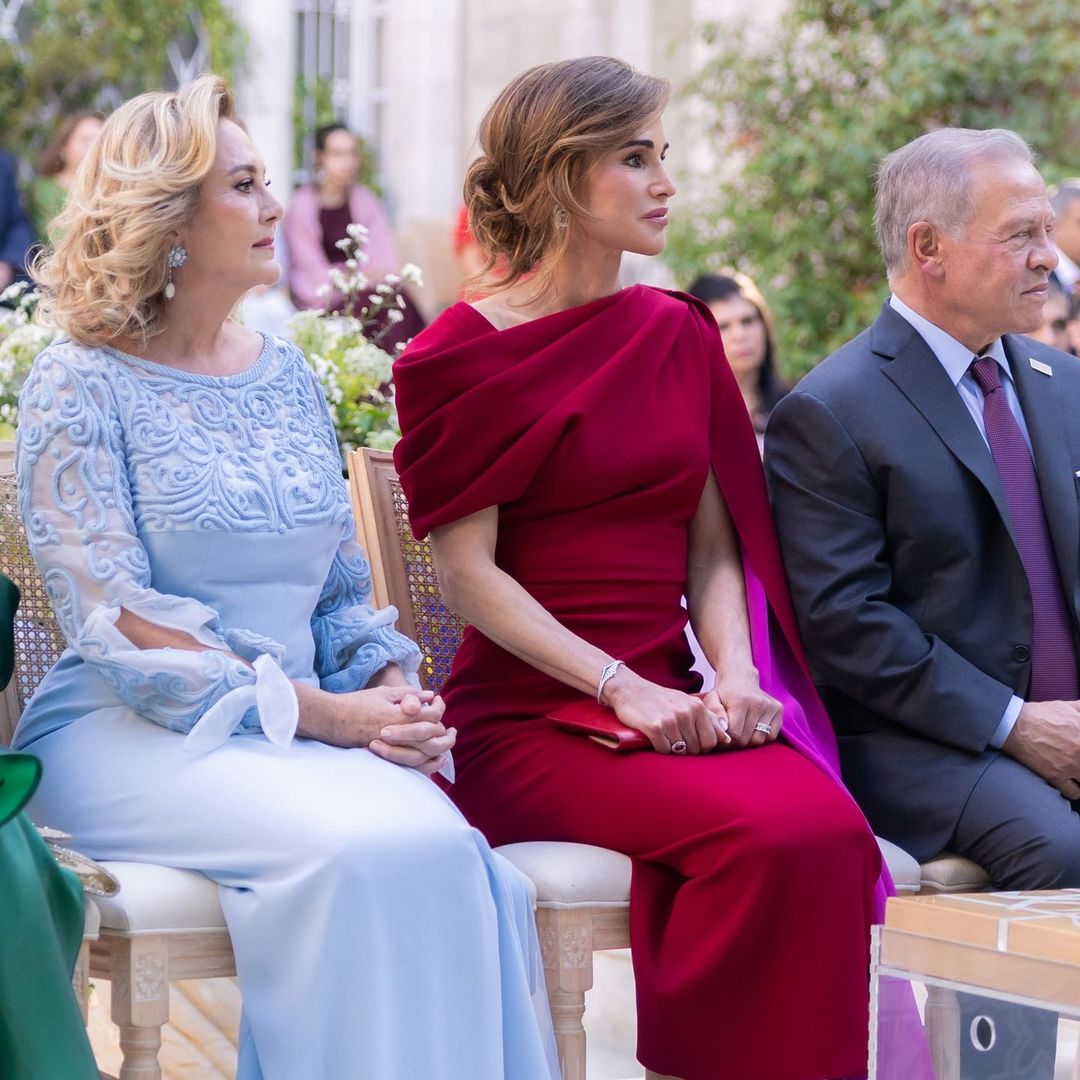
The Hashemites can trace their descent, generation by generation, all the way back to the Prophet Muhammad. It's a documented lineage that royal genealogists rank among the most complete in the world, rivaled by few ruling houses on Earth. That depth of record is what makes the family's habit of producing twins so easy to trace, and so hard to write off as coincidence. It didn't start with Talia and Rania, and not even with their grandmother, but with the very first queen Jordan ever had.
 © @queenrania
Two sisters, two thrones
Long before Jordan existed as a kingdom, two brothers — Abdullah bin al-Hussein and Faisal bin al-Hussein — fell for two sisters: Musbah and Huzaima bint Nasser, the twin daughters of Sharif Nasser Pasha of Mecca.
Both couples married in Istanbul in 1904. Abdullah went on to found the Emirate of Transjordan and become Abdullah I, its first king; his marriage to Musbah produced the heir who continued the line, Talal I, born in 1909.
Huzaima's path took her further still — she became queen consort of Syria in 1920, then queen of Iraq at her husband Faisal's side from 1921 until he died in 1933, staying on as queen mother through her son Ghazi's reign until she died in 1935.
That twin bond sits at the root of the family tree. Jordan's very first queen was born a twin — making the arrival of twin girls over a century later feel less like a fluke and more like a family trait reasserting itself.
 © @queenrania
A trait that keeps resurfacing
The pattern didn't stop with Musbah and Huzaima. King Hussein I and Princess Muna's marriage produced twin daughters, Princess Aisha and Princess Zein. They are the sisters of the current monarch, King Abdullah II, and the first twins born directly into the Hashemite royal court itself.
A generation on, Princess Sumaya bint El Hassan — granddaughter of King Talal I through her father, Prince Hassan bin Talal — welcomed twins Tareq and Zein Al-Sharaf in 1994. Three years later, in 1997, Prince Faisal bin Hussein, King Abdullah II's brother, and his wife announced twin daughters of their own, Aisha and Sara. Then came Prince Talal bin Muhammad — himself a grandson of King Talal I and a first cousin of King Abdullah II — whose twins, Prince Muhammad and Princess Rajaa, arrived in 2001.
Talia and Rania, born to Princess Iman and her husband Jameel Alexander Thermiotis on August 14, 2026, are simply the newest entry on that list — proof that in this particular royal bloodline, twins are less an anomaly than an inheritance.
The adorable family photos were shared on Queen Rania's Instagram (@queenrania)
 © @queenrania
The rest of Europe has its own streak
The Hashemites aren't the only dynasty with plenty of twins in their lineup. Monaco, Luxembourg and Denmark have all had their own run of royal twins reshaping, or at least reordering, their family trees.
Prince Christian of Hanover and his wife, Alessandra de Osma, welcomed twins Nicolás and Sofía in 2021. Denmark's King Frederik X and Queen Mary have Prince Vincent and Princess Josephine, born in 2011, the youngest of their four children.
Monaco's Prince Albert II and Princess Charlene welcomed Princess Gabriella and Prince Jacques, the heir to the throne, in 2014. Belgium's Prince Nicolas and Prince Aymeric, sons of Prince Laurent and Princess Claire and nephews of King Philippe and Queen Mathilde, were born in 2005. And in Luxembourg, Prince Jean and Princess Margaretha, children of Grand Duchess Joséphine-Charlotte of Belgium and Grand Duke Jean, hold the distinction of being the longest-lived royal twins on the continent, born back in 1957.
Seen against that backdrop, Talia and Rania's arrival looks less like an isolated headline and more like the latest line in a story European royal houses have been writing repeatedly, for generations.
 © @queenrania