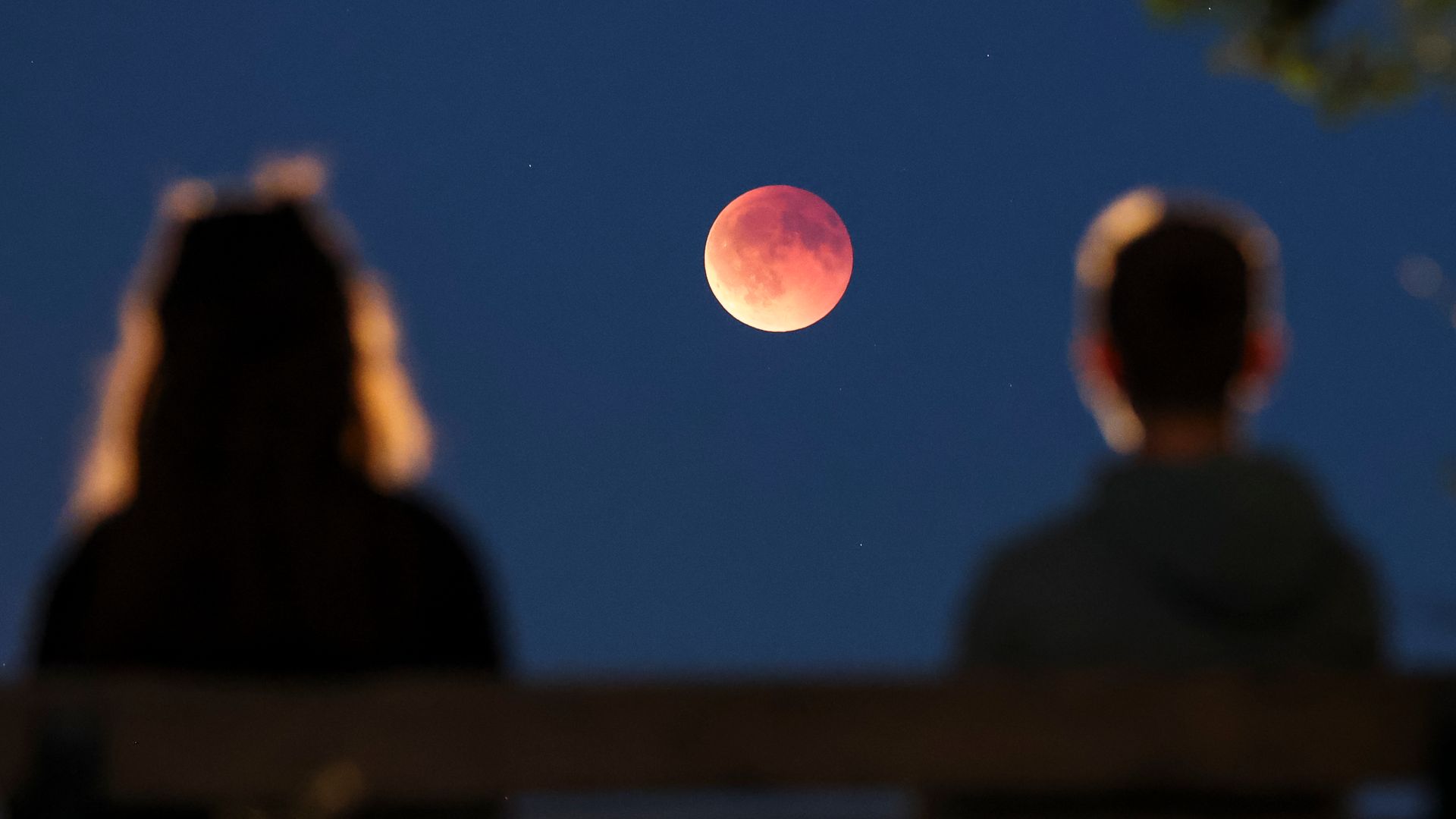
Moon enthusiasts, get ready because the first major astronomical event visible in 2026 is days away. The Earth will come between the sun and the moon, making a total lunar eclipse, or “blood moon.” The phenomenon is a highly anticipated event for stargazers because the entire lunar disk takes on a reddish color.
 © Getty
The magic in the sky will happen on March 3 and will be clearly visible in North and Central America, while in Central and South Asia, it will only be partially visible. Sadly, it will not be visible in Europe or Africa.
Although the eclipse will begin in the early morning, totality will occur almost at dawn on March 3. A few hours before sunrise, the full moon will glow red for nearly an hour during totality. You don't want to miss it because the next total lunar eclipse isn't until New Year's Eve 2028, and the last one visible from North America is June 25-26, 2029.
How and when to watch the total eclipse
 © Getty
Times of the Total Lunar Eclipse or “Blood Moon”
- Eastern time: 6:04-7:02 a.m. EST (in most areas, moonset occurs during totality)
- Central time: 5:04-6:02 a.m. CST
- Mountain time: 4:04-5:02 a.m. MST
- Pacific time: 3:04-4:02 a.m. PST
- Alaska time: 2:04-3:02 a.m. AKST
- Hawaii time: 1:04-2:02 a.m. HST
It's safe to view a total lunar eclipse, unlike a solar eclipse. You don't need any special equipment. Just go to a high vantage point and dress warm for the exciting night ahead.
Keep in mind that at the time of totality, the moon will be almost touching the horizon, about to disappear. That's why it's necessary to view it from a high place, with no buildings or trees blocking your view.
.
Live streams
If you can't watch it in person, there are multiple livestreams on YouTube you can check out.
Timeanddate.com will stream live views from around the world, hosted by Graham Jones and Anne Buckle, with additional feeds from Hawaii, Australia, and near Los Angeles. Here.
Griffith Observatory will livestream the eclipse from 12:47 a.m. to 6:25 a.m. PST on March 3. With California perfectly positioned, this stream is expected to capture the entire event, start to finish. Here.
The Virtual Telescope Project: Founded by astrophysicist Gianluca Masi, the Virtual Telescope Project will curate a global livestream starting at 3:30 a.m. EST, featuring real-time views from North America and Australia. Here.
Why does the moon turn red?
 © Getty
During a total lunar eclipse, the moon doesn’t disappear; it shifts into a muted red glow. That happens when Earth moves directly between the sun and the moon, casting its shadow across the lunar surface.
But Earth’s atmosphere changes everything. As sunlight passes through it, shorter blue wavelengths scatter, while warmer reds and oranges continue through, similar to what happens during a sunset. That filtered light reaches the moon, tinting it red instead of black.
The light coming from the sun and passing through the Earth's atmosphere manages to reach the moon. Those already filtered rays impact the satellite, painting it red. “It's as if all the world's sunrises and sunsets are projected onto the moon,” NASA explains.
Total lunar eclipses are slightly rarer than total solar eclipses. A blood moon occurs every 2.5 years on average, while a total solar eclipse happens about every 18 months, according to NASA's astronomical catalogs.
Total lunar eclipses feel more common because anyone on the night side of Earth can see them. Total solar eclipses, on the other hand, are far more limited; you have to be standing in the exact, narrow path of totality to catch the full show.