Artificial intelligence can spark a debate that can go on for hours, hitting every angle of the human experience. As technology continues to advance, it's hard to tell what's real and what's fake. While we hear about AI being used for terrible things like deep fakes, the jobs humans are losing as a result, and the possible worst-case apocalyptic scenarios, you don't always hear about what seems like a more positive use of the technology, like learning.
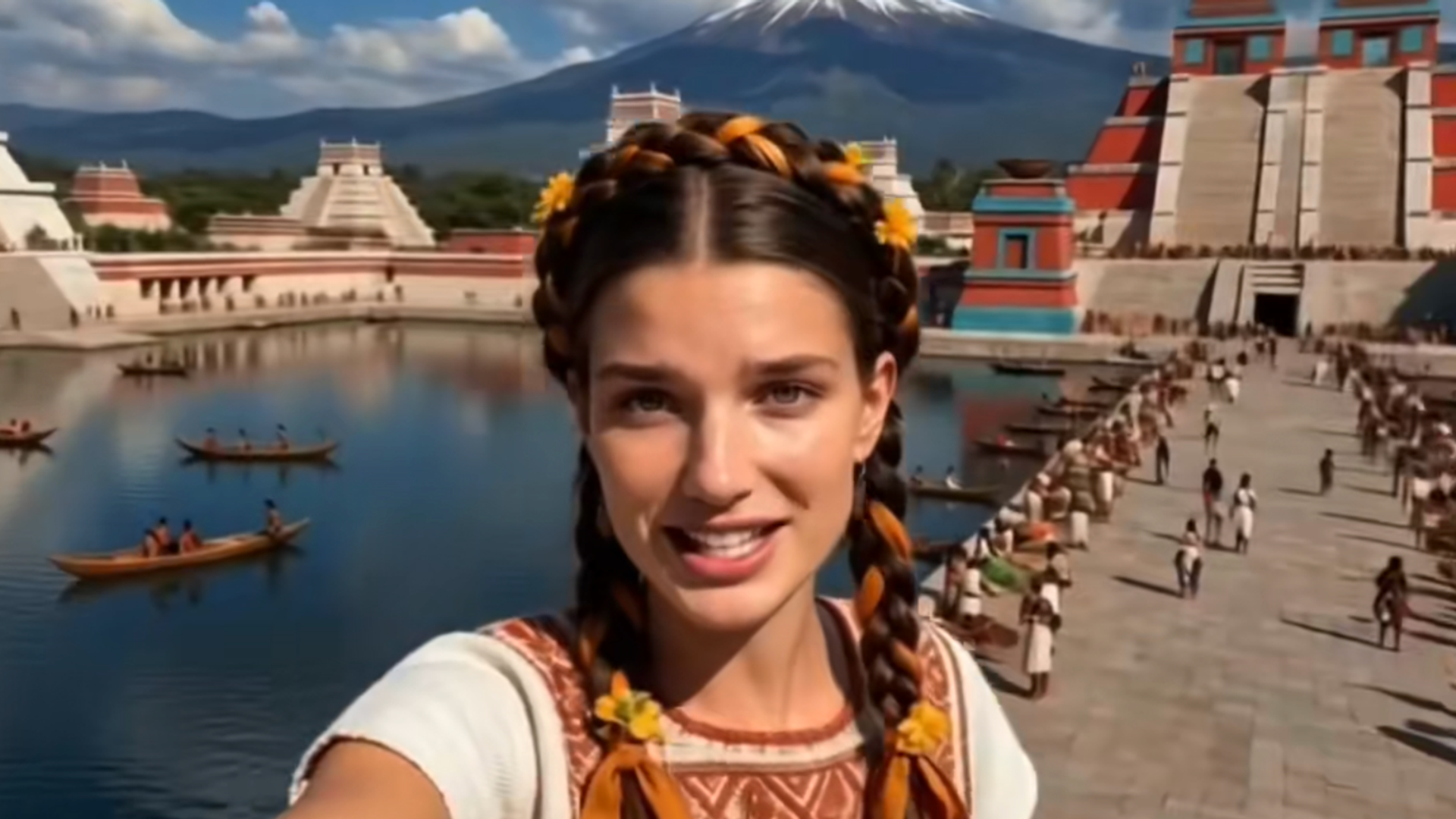
There is a content creator on TikTok named Chloe who, at first glance, looks like a real person. There are even people in the comments of every video asking if it's real. With her great style, tattoos, and crop tops, she exudes girl-next-door energy.
But Chloe isn’t influencing you into how to reach your protein goals or laser your face away; she’s talking about history and using artificial intelligence to bring it to life.
On TikTok, Chloe vs. History has over 100k followers and over 1.7M likes, where she time-travels to pivotal moments in history and shares an impressive amount of information in minutes with witty charm.
She does food reviews in 1536 Tudor England, goes to the first World Cup in 1930, tries to warn people about JFK Jr’s assassination and the Titanic, and visits the Aztecs in Tenochtitlan in 1520.
The videos are filled with comments like, “the only AI I will always love,” and “Whoever invented this must have a degree in using AI correctly.” But there are also some negative ones, “Proof AI doesn’t have any use in creative industries gen sounds so emotionless and just sounds the same the entire time, someone rote. “It’s so creepy AI is taking over everything,” added another.
Despite her TikTok bio describing her as “just a girl from L.A. lost in history,” the person behind the account is actually Jonathan Laramy, a British millennial and U.K.-based social media strategist with a passion for history.
Laramy told Fox News he always believed there was space for an AI history influencer. “History is a little bit dry in general on YouTube and other places,” he said in a recent interview. “It just needed a bit of freshening up.”
While the use of AI allows people to see worlds they only read about in history books, there's a growing fear of what our human experience will look like and its effect on the planet. As the lines of reality, creativity, and human labor continue to blur, so do the questions surrounding authenticity, trust, and what remains uniquely human.