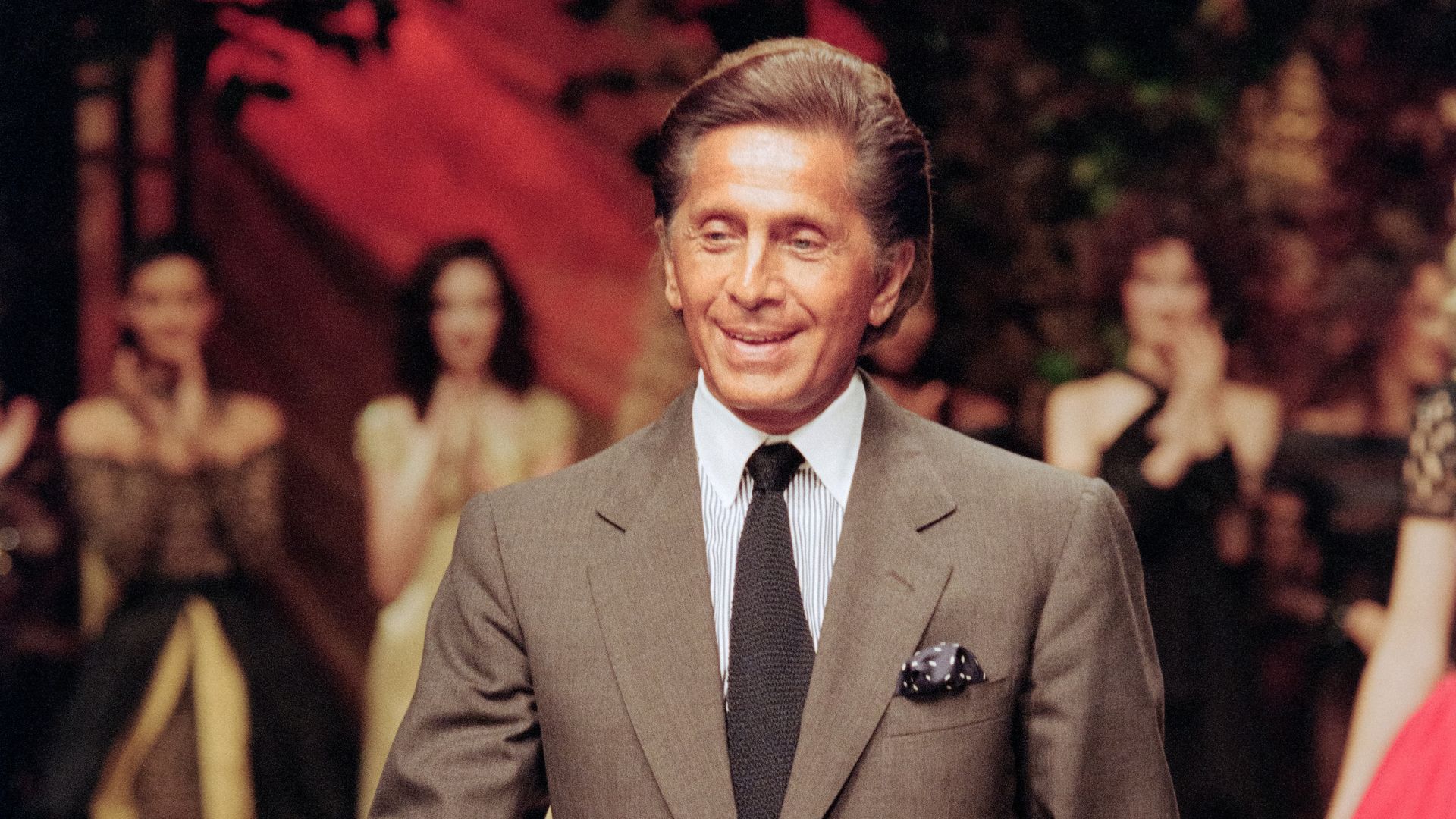
The death of Valentino Garavani has not only left an irreplaceable void in the history of fashion, it has set in motion a succession machine as complex as one of his haute couture gowns, known for being fascinating, opaque, historic, and unapologetically lavish.
With no direct descendants and no spouse, the “Last Emperor” leaves behind a fortune that conservative estimates place at €1.5 billion, though financial analysts and luxury-industry insiders suggest that, once intangible assets and the true market value of his properties are factored in, the figure could climb closer to €2 billion.
Born Valentino Clement Ludovico Garavani in Voghera, Lombardy, in 1932, Valentino was not merely a couturier, he was the architect of an aesthetic canon designed for eternity.
He lived surrounded by castles, yachts and masterpieces, but his greatest work of art was his ability to turn personal relationships into the engine of an empire. He stepped away, at least from needle and thread in 2008, with a historic farewell show at Rome’s Ara Pacis Museum, encircled by his Valentino Girls in red.
One of his greatest creative hits was, undoubtedly, Valentino Red. Legend has it that his fascination with the shade began during a night at the opera in Barcelona, when, as a student, he spotted an older woman in red seated in a box. For him, the color was never merely a hue, it was a declaration of strength, femininity, passion, and elegance.
His intuitive understanding of the female body earned him the devotion of the world’s most iconic women. Jackie Kennedy, for whom he designed the ivory lace wedding dress she wore to marry Aristotle Onassis in 1968. Elizabeth Taylor, Sophia Loren, and Julia Roberts, forever linked to the black-and-white empire-line Valentino vintage she wore when she finally won her Oscar.
Another milestone was the White Collection of 1968, which explains why white flowers filled his chapel of rest when he passed away on January 19. At a time of psychedelic color and hippie exuberance, Valentino unveiled an all-white and beige collection, introducing for the first time his iconic “V” logo.
How Valentino built his empire:
Beyond selling beautiful dresses, Valentino, alongside his inseparable partner Giancarlo Giammetti, proved to be a visionary businessman. The turning point came in 1998, when they sold the maison to the HdP holding group for around €260 million.
That was only the beginning. Valentino retained image rights, royalties, and licensing agreements that continued to generate millions even after his official retirement in 2008.
This immense liquidity was managed through sophisticated financial engineering overseen by Dutch lawyer Ronald Feijen and Valentino’s nephew Piero Villani, often described as the “engineer” of the family fortune.
The wealth moved through a network of holding companies in Luxembourg, the Netherlands and the Channel Islands, an architecture designed not only to preserve capital, but to grow it through reinvestment in assets that now lie at the heart of the succession puzzle.
Real Estate, yachts and a hidden treasure:
Valentino’s real-estate portfolio is perhaps the clearest piece of the puzzle, though its true market value far exceeds what appears on official balance sheets.
In France stands the 17th-century Château de Wideville, surrounded by Versailles-style gardens and purchased in 1995 as his favorite retreat. In Rome, his villa on the Via Appia Antica, with more than 30 rooms, is a museum in its own right and the site of his lying-in-state.
Add to that the Gifferhorn Chalet in Gstaad, a Park Avenue penthouse in New York, a residence in London’s Holland Park, and a property perched between Capri and Anacapri overlooking the Bay of Naples.
Then there is the TM Blue One, his 46-meter superyacht, where he summered with friends like Madonna, Naty Abascal and Gwyneth Paltrow. Its annual upkeep alone exceeding €1 million.
Yet the true hidden treasure lies on his walls, a private art collection spanning Picasso to Warhol, whose precise valuation remains one of the best-kept secrets of the succession.
The will and the ‘chosen family’:
With no direct heirs, the will, already deposited with a Roman notary, becomes the sole roadmap. Italian law protects a “legitimate share” for blood relatives, including his sister Vanda Garavani and his great-nephew Oscar Garavani, who has kept the surname alive in fashion.
But emotionally and materially, the inheritance seems to tilt toward Valentino’s “chosen family," those who sustained his private and professional life.
At the center stands Giancarlo Giammetti, partner, former lover and lifelong guardian of the empire. Much like Pierre Bergé to Yves Saint Laurent, Giammetti is widely seen as the moral heir and is expected to assume full control of the Valentino Garavani and Giancarlo Giammetti Foundation, which may receive a substantial share of liquidity to ensure the designer’s legacy endures through museums and educational programs.
Also in the inner circle are Sean and Anthony Souza, sons of Brazilian Carlos Souza, Valentino’s close friend and global brand ambassador. Raised as the children Valentino and Giammetti never had, they are rumored to inherit properties such as the French château or the London home.
And then there is Vernon Bruce Hoeksema, Valentino’s last great love and the creative force behind luxury accessories label VBH. The first, and perhaps biggest, Gordian knot of the estate. Hoeksema recently injected €550,000 to close bankruptcy proceedings tied to his company, a move many interpret as an advance, or safeguard, ahead of the will’s reading.
Controversy:
Unlike the mansions, cash and financial investments are scattered across elite institutions such as Coutts & Company in London, the private bank of Britain’s upper crust and the late Queen Elizabeth II.
Tracing and valuing these assets, complicated further by Valentino’s shifting tax residences between London, Geneva, and Milan, could spark a bureaucratic battle of epic proportions.
Determining his primary residency at the time of death will dictate which country claims the lion’s share in inheritance taxes, potentially amounting to hundreds of millions of euros.
Adding drama is the collapse of Hoeksema’s VBH empire. Its exotic python and crocodile bags made in Pontassieve and worn by Michelle Obama, Gwyneth Paltrow, Jennifer Lopez and Sarah Jessica Parker, the brand succumbed to years of losses.
In January 2025, a Roman court formally closed the bankruptcy of Atelier Realm srl, its manufacturing arm. Ironically, VBH bags have since become collector’s items, fetching up to €14,000 at auction.
A final twist:
Insiders speculate about a “shock clause.” Could the will require heirs to keep the art collection intact? Or reveal secret investments in digital technology, ensuring his image and style continue to generate posthumous income through AI? Some believe the real twist will be one in which the bulk of liquidity fortifies the Foundation, prioritizing cultural and philanthropic legacy over personal enrichment.
When the will is opened, it won’t just distribute villas and yachts. It will unveil the final masterpiece of a man who designed his life with the same obsessive precision, elegance and mystery as the iconic Valentino Red that changed fashion forever.
Who’s who in Valentino’s inheritance:
Giancarlo Giammetti: More than a potential beneficiary, Giancarlo Giammetti is widely regarded as Valentino’s moral heir. The two met in 1960, and although their romantic relationship ended years later, their personal and professional bond never did.
Vernon Bruce Hoeksema: Valentino’s most recent life partner, Vernon Bruce Hoeksema, played a discreet but significant role in the designer’s later years.
Sean and Anthony Souza: Though Valentino never had biological children, Sean and Anthony Souza filled that role in his life. The sons of longtime friend and brand ambassador Carlos Souza, they were raised under Valentino’s protective wing and considered part of his inner family.
Piero Villani and Oscar Garavani: Italian law mandates that blood relatives receive a protected share of the estate. Piero Villani, Valentino’s nephew, has long acted as the quiet architect of the family’s finances, managing complex banking and holding structures across Europe.
Oscar Garavani, the designer’s great-nephew, represents the youngest branch of the family tree, keeping the Garavani name present in the fashion world through his own creative pursuits.
The foundation: Beyond individuals, the Valentino Garavani–Giancarlo Giammetti Foundation stands as a central beneficiary. Much of the designer’s art collection, couture archives and cultural assets are expected to pass to the foundation, ensuring that his castles, palazzi and creations serve not as trophies to be sold, but as living centers of education, philanthropy and design.
The final curtain: Hovering over it all is Ronald Feijen, the Dutch lawyer who engineered Valentino’s complex estate structure. His meticulous planning may include conditions designed to keep the patrimony intact, granting use without full ownership, and encouraging unity among heirs long after the patriarch’s final bow.
Whether the empire remains whole or fragments into separate fortunes will ultimately depend on the choices Valentino made behind closed doors, in what may prove to be his last and most carefully crafted masterpiece.