In the language of fashion, Valentino Garavani always understood that clothing could speak long after its creator fell silent. With the death of the legendary Italian couturier at 93, those messages feel louder than ever, worn by women who knew the power of a dress.
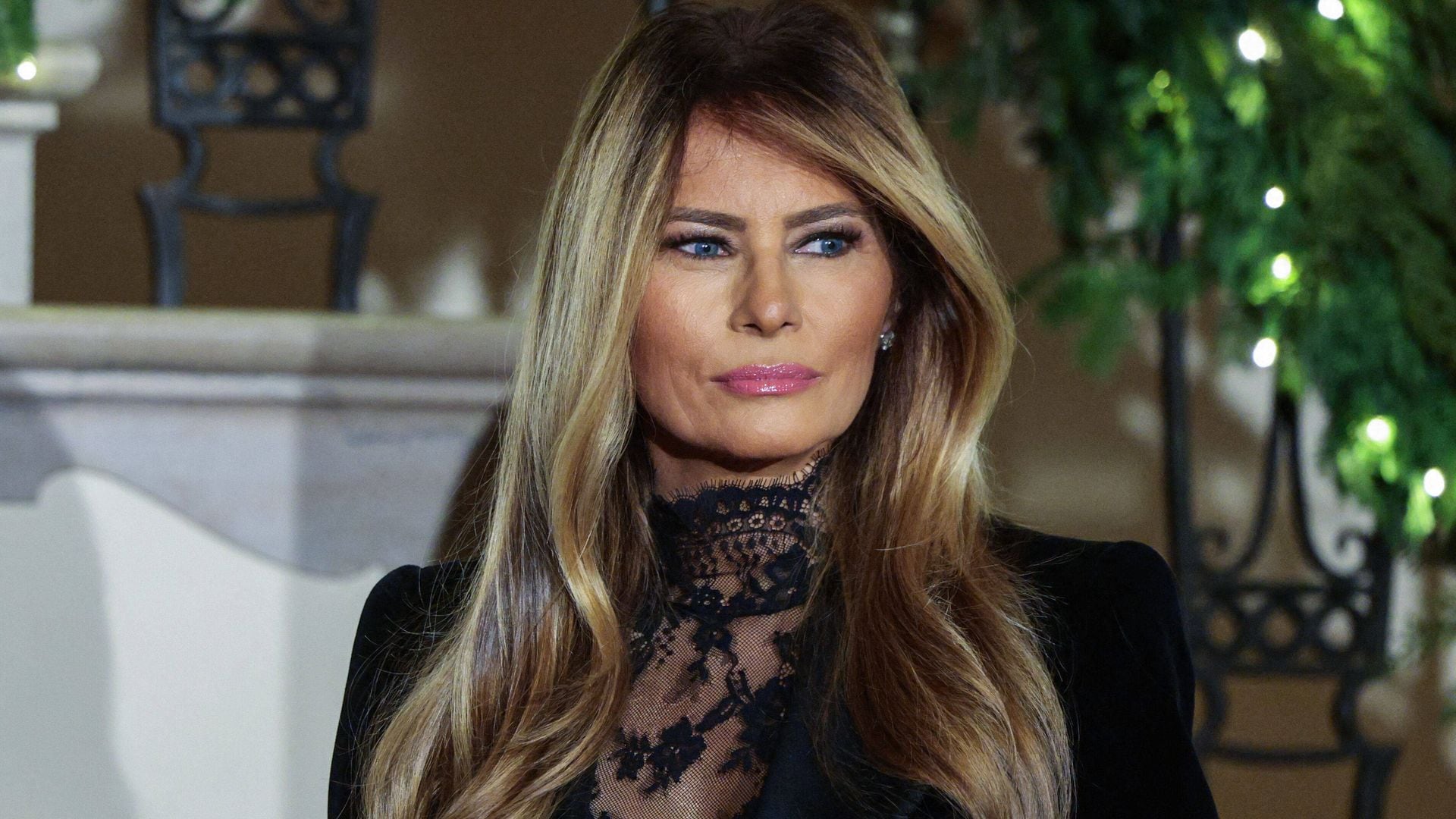
Among them was Melania Trump, whose relationship with Valentino’s work spanned diplomacy, ceremony and moments of quiet symbolism. Valentino’s passing marks the end of an era. For decades, he dressed queens, movie stars and first ladies with a singular understanding of elegance as both armor and language.
“I know what women want, they want to be beautiful,” he said in 2009, a deceptively simple statement that underpinned a multi-million-dollar empire built alongside his longtime partner Giancarlo Giammetti.
By the time Melania Trump entered the global stage as First Lady, Valentino himself had already retired from his eponymous brand. Yet his influence remained deeply embedded in the house he founded.
In July 2017, during a Bastille Day visit to Paris, Melania chose a floral jacquard Valentino dress to watch the military parade along the Champs-Élysées.
Designed by Maria Grazia Chiuri and Pierpaolo Piccioli for the Resort 2017 collection, the dress carried a subtle historical resonance. Its floral motif paid homage to the carnations, poppies and wheat carried by Parisians celebrating the liberation of the city in May 1947.
“I love Valentino, period,” her stylist Herve Pierre declared at the time. The choice echoed a lineage of women who had used Valentino not just for beauty, but for messaging.
Jackie Kennedy did it before her, as did royal consorts across Europe. Melania’s selection telegraphed her own understanding of the First Lady role, one defined by restraint, symbolism and carefully chosen silence.
That language resurfaced again in January 2025, when Melania Trump accompanied her husband, President-elect Donald Trump, to the State Funeral Service for former President Jimmy Carter at Washington National Cathedral.
She arrived in a black Valentino trench coat dress, belted at the waist, its severity softened by a dramatic collar. Printed in black and white, the collar depicted a couple kissing among roses and butterflies, a design drawn from Valentino’s fall 2019 collaboration with Undercover.
Against the solemnity of the occasion, the detail felt intimate, almost private, a reminder of Valentino’s lifelong belief that romance had a place even in restraint.
That same quiet strategy was on display in June 2018, when Melania Trump welcomed Spain’s King Felipe VI and Queen Letizia to the White House.
For the official visit, the First Lady chose an olive green and light beige Valentino cotton dress embroidered with delicate white leaf motifs. The look was refined and restrained, carefully calibrated for diplomacy rather than spectacle, and firmly in line with Valentino’s long-standing association with European aristocracy and understated luxury.
The choice carried particular weight given the guest list. Queen Letizia, herself a seasoned dresser with a sharp understanding of fashion diplomacy, has long favored European powerhouses like Hugo Boss and Carolina Herrera.
By selecting Valentino, Melania positioned herself within the same visual language of royal consorts who use clothing to signal respect, continuity and cultural fluency.
Valentino’s ability to dress across political and social divides had always been part of his mystique. Like his compatriot Giorgio Armani, he clothed women of every ideology. From Jackie Kennedy to Melania Trump, his designs became markers of taste and intent rather than allegiance.
Jackie Kennedy famously turned to Valentino in the aftermath of John F. Kennedy’s assassination, ordering six dresses that formed the core of her mourning wardrobe and helped establish Valentino as a major European force.
Princess Diana also turned to Valentino in the early 1990s as her marriage unraveled, stepping out in a burgundy cocktail dress that reflected a growing confidence beyond royal constraints.
Julia Roberts revived vintage couture when she accepted her Oscar in 2001 wearing a black-and-white Valentino gown from 1992, a moment that reshaped red carpet fashion.
Royal brides trusted him, too. He designed the wedding gown for Marie-Chantal Miller’s marriage to Crown Prince Pavlos of Greece in 1995, a lace and ivory creation watched by royalty and broadcast across continents.
As fashion remembers Valentino Garavani, it is fitting that his legacy lives not only in archives and museums, but in moments like Melania Trump standing quietly in Paris or walking into a cathedral, a message hidden in plain sight. Valentino always knew that a dress could do more than adorn. It could speak, even when its creator no longer could.