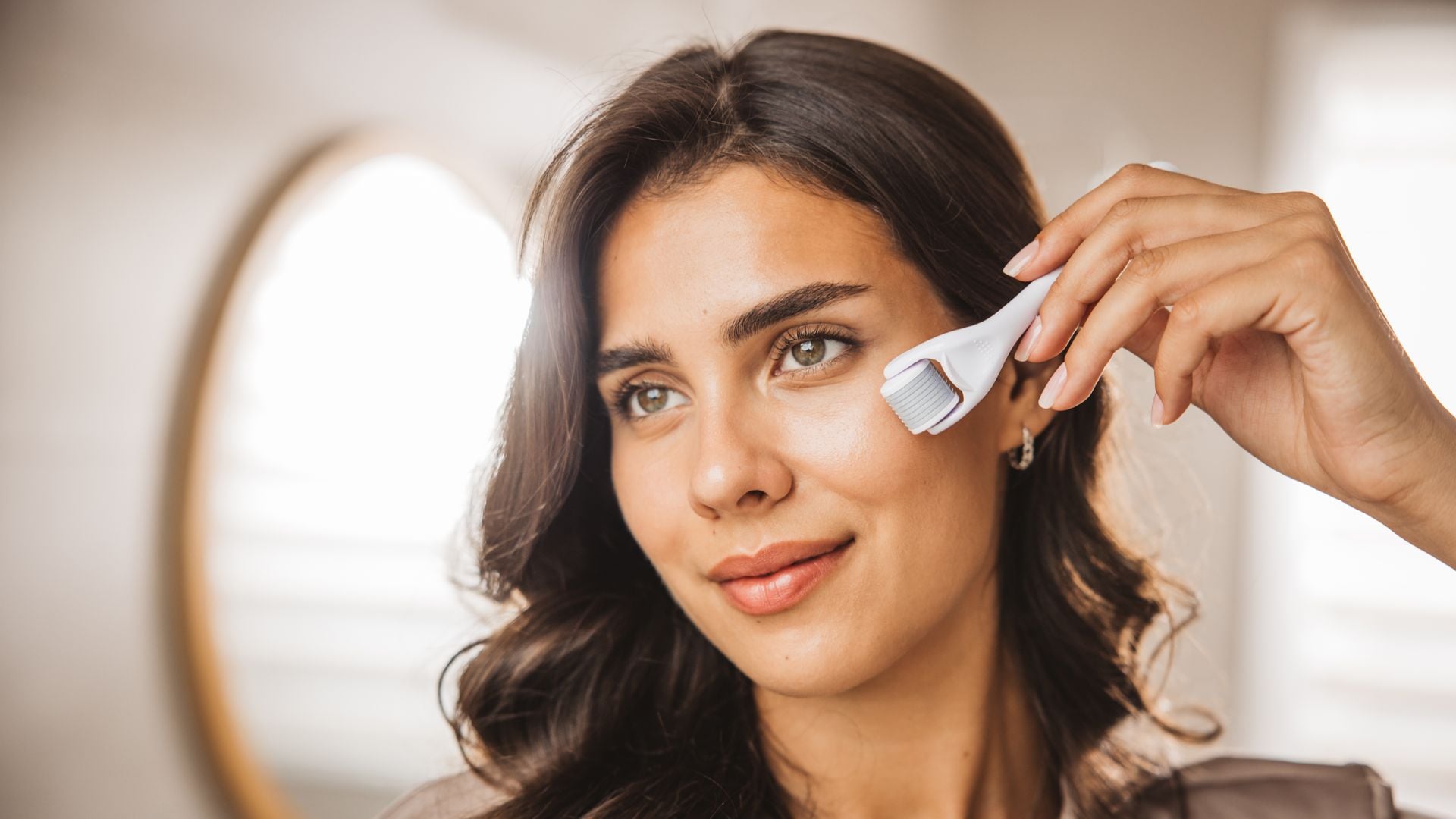
At-home microneedling has officially joined the “DIY aesthetics” wave, right alongside red light masks and at-home devices that used to live only in treatment rooms. Below, industry veterans tied the trend to two big forces: smarter consumers and tighter budgets.
Giovanna McCarthy, founder of PDO Max and LoomEnvy Skincare, put it plainly: “The consumer has become really savvy… they’re educated, they’re very educated on products.” She also pointed to economics as a real driver, explaining that many people can’t swing frequent in-office visits but can budget for at-home maintenance between appointments.
Still, savvy does not mean invincible. McCarthy also drew a hard line around unsafe DIY extremes: “I’ve been seeing people do their own threads. I mean, that’s insane to me… if you’re not medical, you shouldn’t be doing anything that could create an infection.”
That warning matters because microneedling sits on a spectrum. Done thoughtfully, it can support glow and texture. Done recklessly, it can invite irritation, infection, and prolonged inflammation.
What “At-Home Microneedling” Should Mean in 2026
A key theme from experts is lower trauma, better skin health, and fewer steps. McCarthy framed the bigger shift as “less trauma, more transformation,” with a focus on protecting the skin barrier before stacking more procedures.
Jaclyn Luongo, a licensed esthetician, echoed the same mindset: “It’s not taking from the skin, it’s really nourishing the skin.”
So, where does microneedling fit? In their view, at-home microneedling is not about chasing aggressive results. It is about controlled, shallow “micro-channeling” that helps supportive ingredients perform better, without pushing the skin into a high-risk zone.
Luongo spelled out the logic and the limits: “PDRN is not injected in the United States. But what we promote and what we feel works is that .5 depth, 0.3 depth, it is infusing micro channeling into the skin, not deep into the dermis. Which is much deeper, and no need to cause pinpoint bleeding, no need to cause that injury.”
The Safety Line: Stay Epidermal, Avoid Drama
If you only remember one thing, remember this: at-home microneedling should not look like a horror movie. McCarthy described why their at-home approach is designed to avoid downtime: “It was created to be able to get it in that epidermal layer without getting into the dermis… so that we don’t break those rules.” Luongo backed that up with a practical cue: “It should not be uncomfortable… it’s an infusion.”
Translation: for at-home microneedling, shallow and gentle wins. Pain, bleeding, and intense redness are not “proof it’s working.” They are signs you may be doing too much.
How to Do At-Home Microneedling More Responsibly
Here’s a smart, minimal framework aligned with what the experts emphasized
- Start with a clean, basic routine. Luongo recommended cleansing first, then applying serum on clean skin: “The serum should be on first, let that really sink into the skin, and then proceed.”
- Plan microneedling for nighttime. Luongo said the stamping-style infusion is “best done in the evening,” then you can follow with a hydrating mask and finish with serum.
- Skip harsh activities around your microneedling session. McCarthy’s guidance was direct: “Avoid active ingredients that night… no glycolic acid, no acids… Give the body at least 24 hours to heal.”
- Keep pressure light and technique simple. Luongo emphasized upward motions, minimal pressure, and comfort: “You’re not using a lot of pressure… it’s an infusion.”
- Think maintenance, not a replacement for in-clinic care.
McCarthy positioned at-home as the support system: “This is to maintain those.” The goal is to stretch time between professional treatments, not to recreate a medical procedure in your bathroom.
Who Benefits Most From At-Home Microneedling
Experts pointed to dehydrated, stressed skin as the category that tends to show the most noticeable improvement when you focus on hydration and barrier support. McCarthy said it clearly: “The most dehydrated skins… the driest, most photo-aged skin. You’ll be surprised.”
Luongo described the feel people report back: “My skin feels bouncier, more supple… it’s hydrated.”
If your skin is already calm, balanced, and well hydrated, you may see subtler changes. If your skin is dry, dull, or looks “tired,” the combination of gentle channeling plus barrier-friendly hydration can be more obvious.
The New Standard: Minimal Steps, Maximum Consistency
A very 2026 takeaway from this conversation is that the future is not a 20-step routine. It’s a controlled plan you can actually repeat. McCarthy: “I don’t see that anybody needs a 20-step skincare routine.” Luongo agreed: “You need the basics. You need three to four steps.”
At-home microneedling fits into that future when it stays in its lane: shallow, clean, consistent, and paired with hydration-first products. Not bravado. Not chaos. Not “DIY medical aesthetics.”
And yes, the universe does not need anyone trying to become their own med spa. Here's where the pushback comes now.
Not All Experts Want You To Do It At Home
Dr. Maria Hurtado, an aesthetic physician who specializes in non-surgical, minimally invasive cosmetic procedures to enhance facial and body appearance, agrees that microneedling is one of the best skincare methods. "In my experience, microneedling is one of the most effective procedures for improving skin quality. It helps with texture, post-inflammatory dark spots, acne scars, and enlarged pores because it naturally stimulates skin regeneration. I always explain that it’s not a tightening treatment, but rather one focused on the health and appearance of the skin."
While Hurtado praises the technique, she clearly emphasizes her pushback on doing it at home. Her concerns center around the potential risks and complications that can arise from at-home microneedling procedures. "It’s important to clarify that this is a delicate procedure, since it involves creating micro-perforations in the skin and there may be fluids present, such as blood. That’s why it must be performed in a treatment room or medical office, under biosecurity protocols, and exclusively by a trained medical professional who is prepared to handle any unexpected issues or complications," she told HOLA!
She believes that without professional guidance and expertise, individuals might not fully understand the proper technique, depth, or aftercare needed for safe and effective results. "It’s also important to educate the patient that the use of needle devices at home should never be attempted or promoted," she warns. "It isn’t a cosmetic, at-home procedure. It’s a treatment that requires clinical judgment and diagnosis, appropriate sanitary conditions, and training in managing the skin and its potential reactions. That’s what truly ensures safety and personalized results."
While at-home microneedling may be the biggest beauty trend of 2026, not all experts agree on the use of these needle devices. Therefore, when considering micro-perforations in the skin, it’s important to think carefully about whether this treatment is worth trying.